
HF-TID Method
A new technique, based on the exploitation of DPS4D ionosondes, is implemented to directly identify TID in real-time. For the real-time detection and evaluation of TIDs remote-sensing data from synchronized, network coordinated HF sounding between pairs of DPS4D ionosondes are exploited.
The method is based on the assumption that the ionosphere is represented by a moving undulated mirror, to relate HF signal parameters to TID characteristics, using the Doppler-Frequency-Angular-Sounding (FAS) technique [Paznukhov et al., 2012]. Measurement of all signal properties (Doppler frequency, angle of arrival, and time-of-flight from transmitter to receiver) proved to be instrumental in detecting the TID and deducing the TID parameters: amplitude, wavelength, phase velocity, and direction of propagation. The signal processing technique applied on HF data is capable of consistently extracting different signals that have propagated along different ionospheric paths. An intelligent system for “signal tracking” has been developed to handle the multi-path signal, based on a neural network model of a pre-attentive vision capable of extracting continuous signal tracks from the multi-path signal ensemble. The performance of the method has been demonstrated with oblique Digisonde-to-Digisonde (D2D) "skymap" observations from European Digisondes (Reinisch et al., 2017). The method can detect electron density perturbations from 5% to 20% of the ambient electron density making possible the identification of both LSTIDs and MSTIDs.
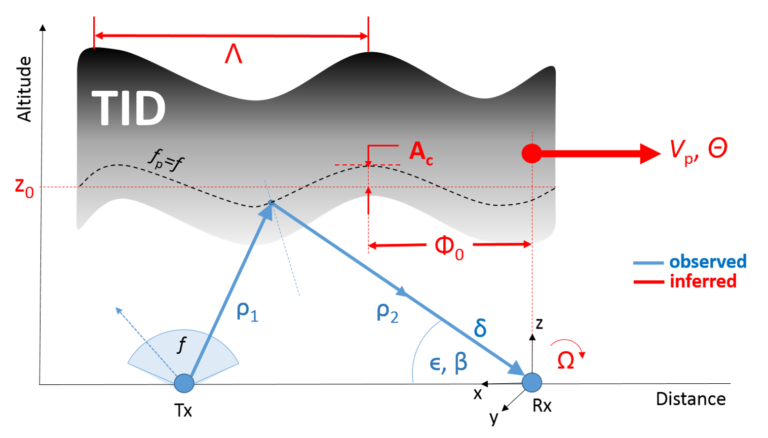
The TID model used in HF-TID method, assumes that the ionosphere is a perfectly reflecting corrugated mirror moving across the area and causing variations of the oblique-incidence signal (blue line) characteristics {ρ(t), δ(t), ε(t), β(t)}.
Huang, X., B.W. Reinisch, G.S. Sales, V.V. Paznukhov, and I.A. Galkin (2016), Comparing TID simulations using 3-D ray tracing and mirror reflection, Radio Sci.,51, 337–43, doi:10.1002/2015RS005872.
Reinisch, B.W., Galkin, I.; Belehaki, A.; et al.. Pilot ionosonde network for identification of travelling ionospheric disturbances, Radio Science, 2017 (under review).
Paznukhov, V.V., V.G. Galushko, and B.W. Reinisch (2012), Digisonde observations of AGWs/TIDs with Frequency and Angular Sounding Technique, Adv. Space. Res., 49(4), 700-710, doi:10.1016/j.asr.2011.11.012.