
GNSS TEC Gradient Algorithms
Large scale Travelling Ionospheric Disturbances (TIDs) occurring during geomagnetic storms produce strong temporal and spatial TEC gradients which are observed closest to the source region of LSTIDs. These gradients are attributed to heating and convection processes which are related to the excitation of LSTIDs (Borries et al. 2017). Temporal and spatial gradients are calculated based on maps of TEC. The figure below presents the results of this method applied on the 20 November 2003 storm. The spatial TEC gradients (top panel) are derived from DLR TEC maps at 15°E. The TEC rate (bottom panel) is derived from DLR TEC maps at 15°E. The white line approximates the trough location. Large-scale TEC gradients are routinely produced by the DLR and the results will be used on TechTIDE for the real-time identification of LSTIDs and the identification of the source region.
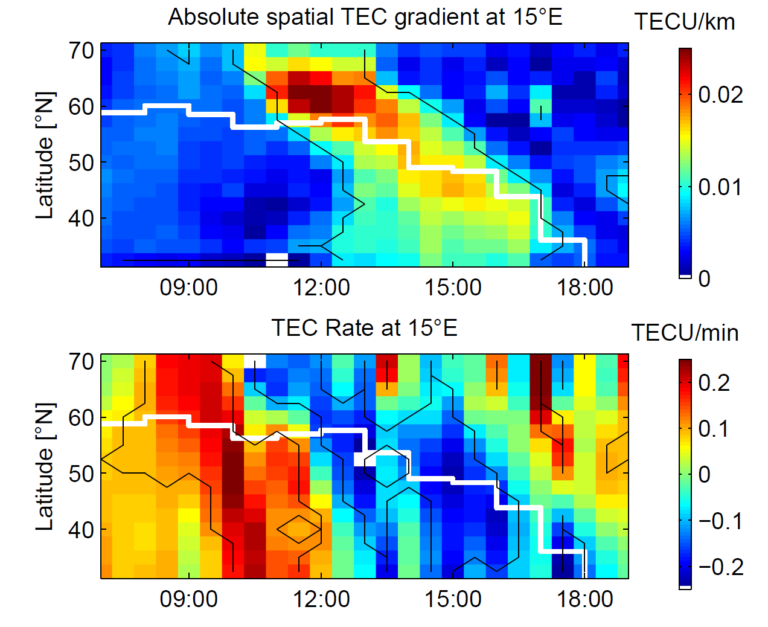
The TEC gradient method results for 20 November 2003. The spatial TEC gradients (top panel) and the TEC rate (bottom panel) are derived from DLR TEC maps at 15oE.
Borries C., N. Jakowski, K. Kauristie, et al. (2017), On the dynamics of Large-Scale Travelling Ionospheric Disturbances over Europe on 20th November 2003, J. Geophys. Res., 122, doi:10.1002/2016JA023050.